Emergency Dental Clinic: Managing the Surge of Patients-in-Pain Calls
Emergency dental clinic: Sophie, the virtual receptionist from Agent IA Vocal, triages patients-in-pain calls and books the same-day appointment 24/7 in Canada.
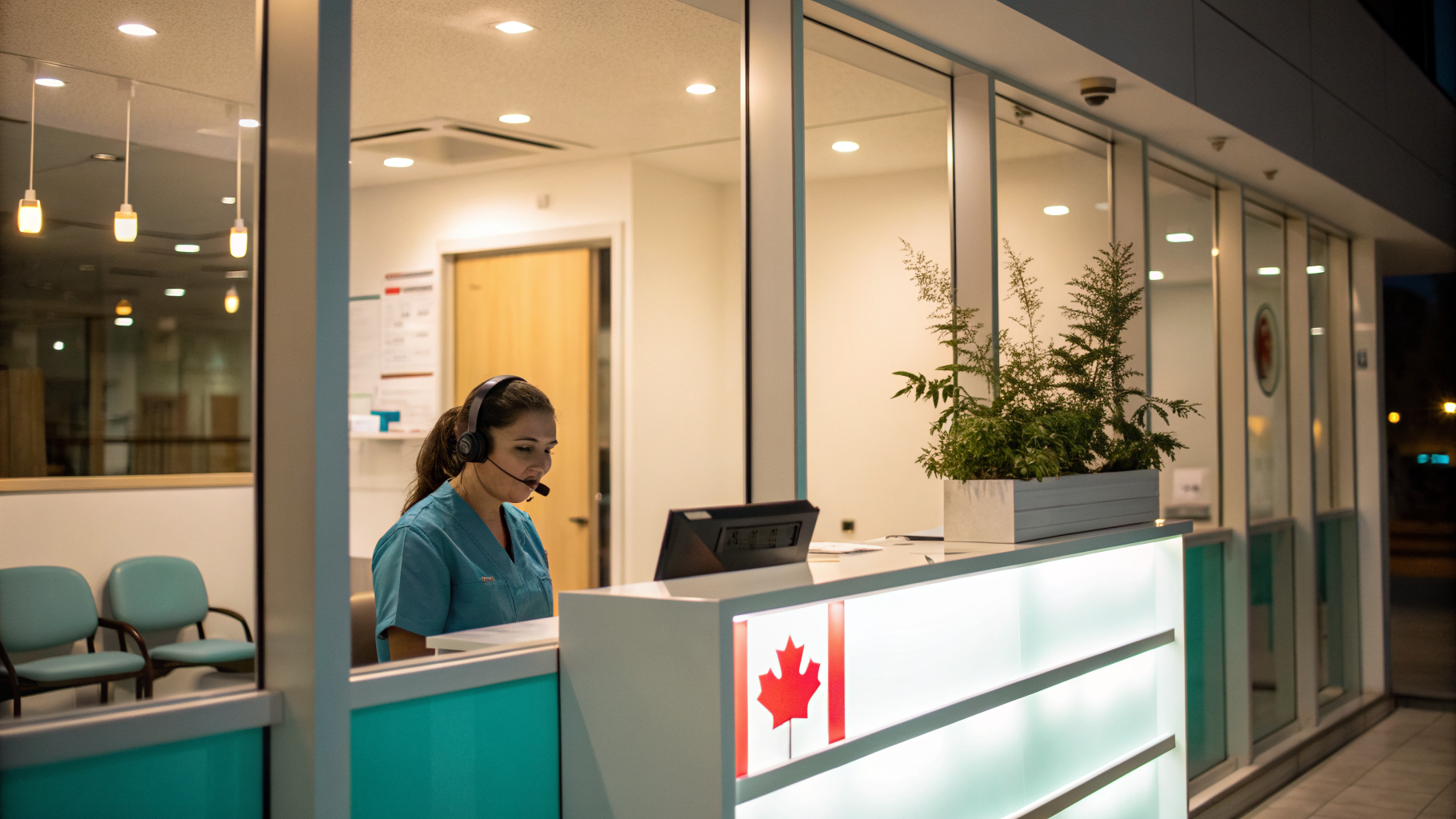
An emergency dental clinic is unlike any other practice. The patient dialling your number is not planning a cleaning three weeks out: they are in pain now, often since the night before, sometimes for the past hour. Their tolerance for waiting is nil, and their ability to dial the clinic down the street is total. The first one that answers with a concrete solution is almost always the one they choose. In this context, the phone is not one channel among many: it is the very core of your business model.
Unlike a general practice whose schedule fills with recurring appointments, an emergency clinic lives on an unpredictable flow. Calls arrive in surges — a Sunday evening, a snowstorm Monday morning, a December 26 — and each surge contains both genuine emergencies and requests that can wait. Triaging quickly, without ever offering a diagnosis, while still booking the right slot, demands an availability few human teams can sustain seven days a week. In Toronto, Vancouver, Ottawa or Calgary alike, the clinic that picks up at 9 p.m. captures the patient three others left on voicemail.
Why dental emergencies are a unique phone challenge
In a conventional practice, a missed call can be recovered the next day. In an emergency setting it never is: the patient in pain does not wait for your callback, they call elsewhere. The volume itself is erratic. A quiet day can flip in fifteen minutes when a school closes, an ice storm causes falls, or a long weekend leaves a region without its usual clinic.
- Peaks strike at the worst moments — early morning, evenings, weekends and statutory holidays, precisely when a human front desk is absent or overwhelmed
- Every call mixes real emergencies, minor worries and general enquiries, with no way to tell them apart before picking up
- A patient in distress tolerates being placed on hold poorly: beyond a few rings, they hang up and dial another number
- A single person at the front desk cannot greet a patient in the chair, process a payment and answer three ringing lines at once
The result is measured directly in lost production. In an emergency clinic, an unanswered call is not merely lost revenue: it is an immediate treatment — an extraction, a root canal, the repair of a dislodged crown — walking to a competitor, along with all the follow-up it would have generated.
The real cost of an uncovered call surge
Consider an example representative of what we see in cities like Edmonton or Winnipeg. An emergency clinic receives 90 calls per week, 55 of which come from patients in pain seeking a same-day appointment.
| Metric | Partial coverage | Every call answered |
|---|---|---|
| Calls from patients in pain per week | 55 | 55 |
| Calls answered | 39 | 55 |
| Conversion rate to booked appointment | 68% | 82% |
| Emergency appointments per month | 106 | 180 |
The gap is not only about how many calls get answered: a patient offered a specific slot during the conversation does not call elsewhere. In an emergency setting, response speed matters even more than usual, because the patient's decision window is measured in minutes, not hours.
Sophie on the front line: triaging without ever diagnosing
That is exactly the role of Sophie, your virtual front-desk receptionist from Agent IA Vocal. Sophie answers 24/7 in English and Canadian French, switching languages mid-call if the patient prefers. From the first ring she applies three-level triage — same day, within 48 hours, or this week — using criteria your team approves in advance, and never offers a diagnosis or clinical advice. A patient describing trauma, heavy bleeding or intense pain is routed to the first available slot or transferred immediately to a human; a less pressing request is scheduled without pulling your staff away.
Sophie checks availability and books appointments directly into Open Dental, Dentitek, ClearDent, Dentrix Canada, Maxident, ABELDent, Curve or tab32, during the conversation. The patient hangs up with a date, a time and a confirmation by email or text. All setup — your triage protocols, your slots reserved for emergencies, your cancellation policies — is handled by the TECHMA team: you configure nothing yourself. The full capability list is at https://dentists.agentiavocal.ca/en/features .
Absorbing surges without ever placing a caller on hold
The strength of a virtual receptionist shows precisely where a human team buckles: the simultaneous spike. Sophie takes ten calls at once as calmly as a single one. No patient hears a busy tone, none waits while the front desk juggles a walk-in. During a storm or a high-traffic Monday morning, this ability to lose no call turns an unpredictable flow directly into confirmed appointments.
Reminders that protect hard-won slots
In an emergency clinic, every slot is precious: a no-show is a slot another patient in pain would have filled on the spot. Sophie sends structured reminders at 2 days and 1 day before the appointment, then follows up 15 minutes after the scheduled time if the patient has not arrived, to rebook or free the slot immediately. Clinics using this protocol see no-show rates fall on average from 14.2% to 8.8% — a 38% reduction.
In an emergency clinic, a slot freed at the last minute is not a dead loss: it is a place Sophie reassigns within minutes to the next patient in pain.
Compliance and privacy, even under pressure
The urgency of the moment never removes the duty to protect personal health information. These conversations are governed federally by PIPEDA, and by Quebec Law 25 where applicable. With Agent IA Vocal, data stays in Canada, hosted on AWS ca-central-1 in Montreal. Call recordings are retained for 90 days by default — a configurable period — then deleted automatically. These practices align with the record-keeping expectations of provincial regulators such as the RCDSO in Ontario, the CDSBC in British Columbia and the ADA+C in Alberta, including when the call comes in at 3 a.m.
Which plan fits an emergency clinic
The Essentiel plan, at $299 CAD/month for one clinic and 200 minutes, suits a small operation whose emergency volume stays moderate. As the surges multiply, the Croissance plan at $599 CAD/month raises capacity to 600 minutes; overage is billed at $0.35 CAD/min. Groups running several emergency locations choose the Multi-cabinets plan at $899 CAD/month, covering up to three sites. Initial deployment by TECHMA is a one-time $999 CAD fee. Full plan details are published at https://dentists.agentiavocal.ca/en/pricing and you can model the impact on your own volume with the calculator at https://dentists.agentiavocal.ca/en/roi-calculator .
Measuring what matters in an emergency setting
An emergency clinic is steered with a few simple indicators, which your Agent IA Vocal dashboard tracks automatically: call answer rate, share of calls converted to same-day appointments, average time to intake, no-show rate, and call distribution by time of day. That last metric is often revealing: it shows how many patients in pain call outside opening hours — exactly the ones no front-desk hire, however good, could ever have captured.
Dental emergencies cannot be planned, but the phone response can be fully mastered. To hear Sophie triage and book a real emergency call exactly as she would for your clinic, book a 15-minute live demonstration at https://dentists.agentiavocal.ca/en/live-demo .