Post-Operative Follow-Up: Managing After-Surgery Calls at Your Dental Practice
Post-operative follow-up calls in Canadian dental practices: after-surgery triage, automated reminders and PIPEDA-compliant handling around the clock.
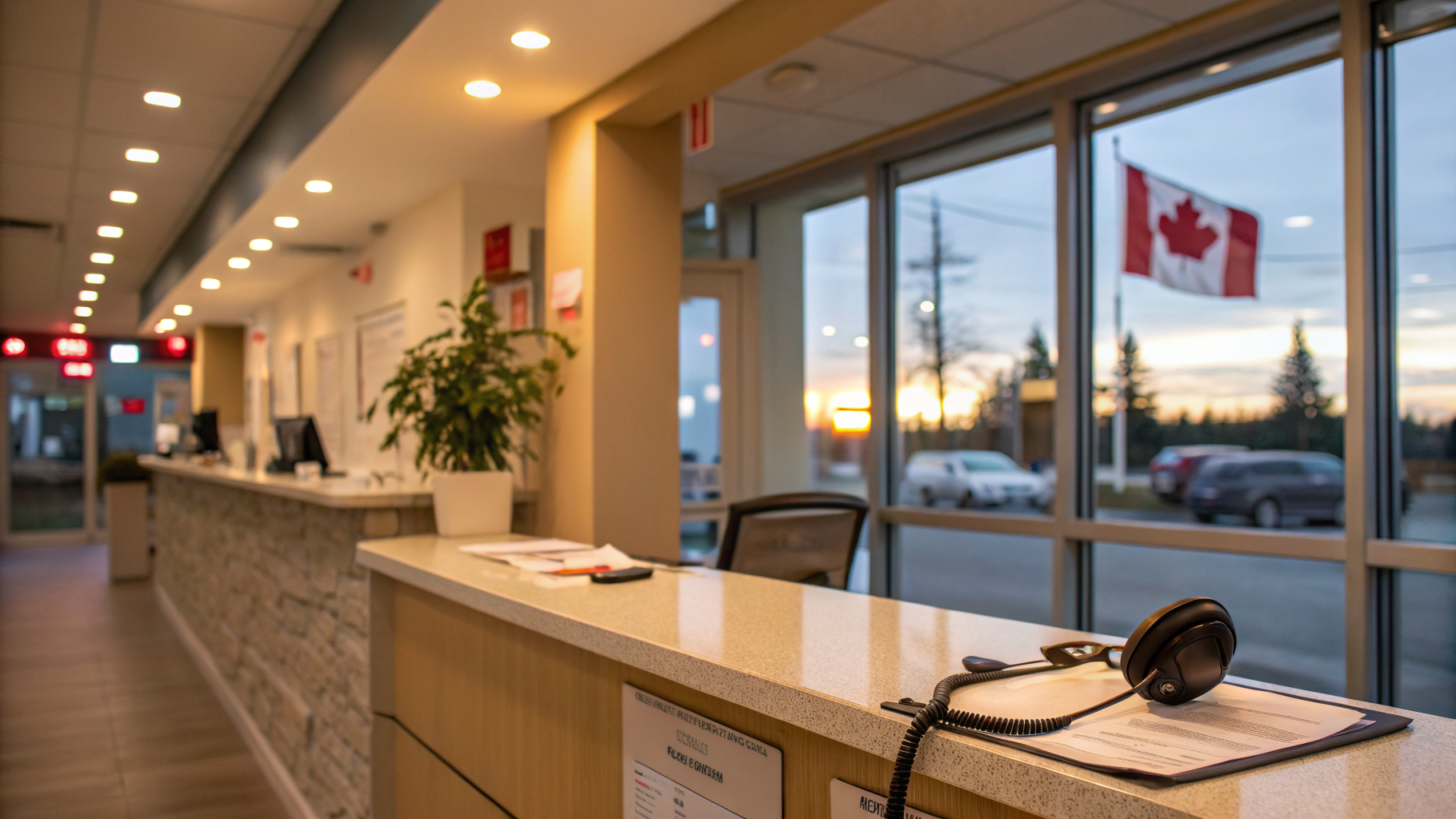
A wisdom tooth extraction wraps up at 3:30 p.m. on a Thursday. At 9:40 p.m., the patient calls back: the bleeding has restarted, the swelling is spreading, and they no longer know whether what they feel is normal. The practice closed at 5. This scenario repeats itself every week in clinics from Hamilton to Calgary — and how that call is handled determines both the patient's peace of mind and the front desk's workload the next morning.
Post-operative follow-up is one of the blind spots of dental telephony. Practices invest heavily in the surgical protocol, the written take-home instructions and the review appointment, yet the interval between surgery and that review — the window when a patient is most likely to call — often rests on a voicemail box. Here is how Sophie, your virtual front-desk receptionist from Agent IA Vocal, structures that window without ever stepping into clinical judgment.
Why the first 72 hours concentrate the calls
Extractions, implant placements, gum grafts, periodontal surgery: every procedure opens a 48-to-72-hour window during which the patient monitors signals they cannot interpret. Light oozing is expected; bleeding that restarts at 10 p.m. is alarming. Swelling that peaks on day two is well documented; to the patient, it looks like a complication.
The predictable result: post-operative calls arrive overwhelmingly outside office hours. Surgery often happens late in the day, analgesics wear off in the evening, and the questions surface at night or on the weekend. A practice in Mississauga or Edmonton that closes at 5 p.m. leaves the most sensitive period of its own protocol with no phone coverage at all.
The most frequent reasons patients call after surgery:
- Bleeding that restarts or seems unusually heavy
- Pain that increases rather than decreases after 48 hours
- Swelling, fever or an unusual taste that worries the patient
- Medication questions: dosage, a missed dose, digestive discomfort
- Dietary or hygiene instructions only half-remembered at discharge
- A dressing or suture that has come loose
Voicemail: the worst tool for a worried patient
Faced with these calls, voicemail produces three unwanted outcomes. The anxious patient hangs up and redials in a loop, or heads to an already crowded hospital emergency department for bleeding that could have been managed over the phone. The stoic patient does not leave a message and waits — sometimes too long — before reporting a real problem. And the front desk in Burnaby or Surrey starts Monday with a queue of anxious messages to return first, stacked on top of the week's regular call volume.
A patient who is bleeding at 10 p.m. should never land in a voicemail box. They should speak with someone who knows exactly what to do with that call.
That is precisely the role of a virtual receptionist available 24/7. Sophie answers on the first ring, in English and in French — and can switch languages mid-call if the patient prefers — then applies a triage grid defined with the practice. Nothing is improvised.
Three-level triage — never a diagnosis
The distinction matters: Sophie makes no diagnosis and offers no clinical opinion. She classifies the situation the patient describes into three priority levels, exactly as an experienced receptionist would with a written grid in hand:
- Same day: signs requiring prompt attention — heavy bleeding that will not stop, intense pain unrelieved by the prescribed medication, swelling that keeps progressing. Sophie offers the first available emergency slot or transfers the call according to the practice's protocol.
- Within 48 hours: marked but stable discomfort; a priority appointment goes straight into the schedule.
- This week: non-urgent questions — instructions to confirm, a review appointment to move up, a comfort-medication renewal to have validated.
At any point, if the patient sounds distressed, describes worrying symptoms or asks a clinical question, Sophie transfers the call to a human — the on-call dentist or the line the practice designates. That boundary is built into how she works: the technology manages logistics, never dentistry. The approach aligns with what regulators such as the RCDSO in Ontario, the CDSBC in British Columbia and the ADA+C in Alberta expect from patient communication.
Instructions that match your written protocols
Between appointments, teams repeat the same post-operative instructions dozens of times — and every rushed repetition introduces a variation. Sophie relies only on the written instructions the practice has approved: the same wording, in the same order, on every call. The patient in Halifax who calls at 11 p.m. hears exactly the information the dentist validated, nothing more, nothing less. Any question outside that scope triggers a transfer or a priority message, never an improvised answer.
The TECHMA team configures the entire setup: triage grid, approved instructions, emergency slots, transfer rules. The practice configures nothing itself — it reviews and approves, then stays focused on care.
Automated reminders that protect the review appointment
The post-operative review is the appointment patients skip most readily: the pain is gone, and so is the motivation. Sophie applies the same reminder sequence used for every appointment — 7 days, 2 days and 1 day before the review, plus a follow-up 15 minutes after — by phone or email, according to the patient's preference. Across practices using Agent IA Vocal, this sequence has cut missed appointments by 38%, with the no-show rate falling from 14.2% to 8.8%.
For a dentist placing implants, a missed review is not just a hole in the schedule: it is a healing check that does not happen when it should. The automated reminder becomes a continuity-of-care tool as much as a productivity one. You can estimate the impact on your own schedule with the calculator: https://dentists.agentiavocal.ca/en/roi-calculator
Three concrete scenarios
Hamilton, Tuesday, 10:10 p.m. A patient operated on that morning reports renewed bleeding. Sophie follows the grid: the factual questions set out in the protocol, a same-day classification, then a transfer to the on-call dentist as the practice instructed. Total duration: under four minutes.
Calgary, Saturday, 9 a.m. A gum-graft patient wants to double-check a dietary instruction. Sophie reads back the approved instruction, offers to move the review appointment up if the worry persists, and logs the exchange in the record. No interruption for the team.
Winnipeg, Sunday, 8 p.m. A patient has forgotten the dosage of their comfort medication. Sophie gives no advice: she takes a priority message, classifies the call as within-48-hours, and the dentist calls back first thing Monday with the file already annotated.
Booked straight into the patient record
Every post-operative call is logged: reason, priority level assigned, action taken, appointment created. Sophie books directly into the practice management software Canadian clinics rely on — Open Dental, Dentitek, ClearDent, Dentrix Canada, Maxident, ABELDent, Curve or tracker.tab32 — with no manual re-entry. On Monday morning, the team in Hamilton or Surrey does not face a full voicemail box: it opens an already up-to-date schedule with a prioritized call log beside it.
The full feature list, including emergency triage and software integrations, is detailed here: https://dentists.agentiavocal.ca/en/features
PIPEDA compliance and data kept in Canada
Post-operative calls carry sensitive health information. Agent IA Vocal hosts all data in Canada (AWS ca-central-1, in the Montreal region) and complies with PIPEDA, and with Quebec Law 25 where applicable. Call recordings are kept for 90 days by default — a configurable period — then deleted automatically. The practice remains in control of its data and can document that retention chain during an audit or an access request.
What it costs
| Plan | Monthly rate | Included |
|---|---|---|
| Essentiel | $299 CAD/month | 1 practice, 200 minutes |
| Croissance | $599 CAD/month | 600 minutes |
| Multi-cabinets | $899 CAD/month | Up to 3 locations |
Additional minutes are billed at $0.35 CAD per minute. The one-time deployment fee — full configuration of the triage grid and integrations by the TECHMA team — is $999 CAD. Full plan details are here: https://dentists.agentiavocal.ca/en/pricing
Next step
The most concrete way to evaluate Sophie is to hear her handle a realistic post-operative call: bleeding reported at 10 p.m., a medication question, a review appointment to move up. Book a 20-minute live demonstration and bring your own triage scenarios: https://dentists.agentiavocal.ca/en/live-demo