Reducing front-desk interruptions: freeing your dental team to focus on the chair
Front-desk interruptions cost dental practices real money. Here is how a virtual receptionist filters the phone so the clinical team can focus on care.
The hidden cost of front-desk interruptions
In a dental practice, the phone rarely rings at a convenient moment. It rings while a hygienist is explaining a treatment plan, while a payment is being processed, while an anxious patient is being reassured at the counter. Every call forces the front-desk team to interrupt the task at hand, switch context, and then pick up where they left off. The motion seems harmless, but it adds up.
Research on office work suggests it takes several minutes to fully regain concentration after an interruption. Multiply that by the 40 to 80 calls a mid-sized practice fields each day, add the patients at the counter, the email, and the insurance checks, and the front desk shifts into permanent reactive mode. The consequence is not only stress: it shows up as data-entry errors, mis-booked appointments, missed recalls, and dropped calls during peak hours.
What interruptions actually cost
A missed call is never neutral. For a practice in Hamilton ON or Mississauga ON, a prospective patient who reaches no one rarely calls back — they dial the next number on the list. The lifetime value of a new patient runs into the thousands of dollars, and it only takes a few lost calls a week for the annual shortfall to dwarf the cost of a front-desk solution.
The most insidious cost, though, is internal. When the front-desk coordinator juggles the counter and the phone at once, the quality of every interaction drops. The patient in the chair hears the ringing. The person at the counter gives half an answer because a call is on hold. And the clinical team loses time correcting appointments that were entered in a hurry.
A front desk interrupted every few minutes cannot deliver a calm clinical experience. Attention is a resource, not a given.
Separating the phone flow from the counter flow
The goal is not to take the phone away from the team, but to filter what truly deserves their attention. That is the role of Sophie, your virtual front-desk receptionist. She answers every call on the first ring, around the clock, in both English and French, and switches language mid-call if the patient does.
In practice, Sophie handles the repetitive requests that clog the line: booking and rescheduling appointments, questions about opening hours, address confirmation, and reminders about coverage already on file. She writes the appointment directly into your practice management system — Open Dental, Dentitek, ClearDent, Dentrix Canada, Maxident, ABELDent, Curve, or tracker.tab32 — without anyone at the counter touching the schedule. The team only sees what calls for human judgement.
Three triage levels, never a diagnosis
For emergencies, Sophie applies a three-level triage: same day, within 48 hours, or this week. She never offers a diagnosis. If a patient describes distress or asks a clinical question, the call is transferred to a person. The sorting happens before the team is disturbed, which means a treatment in progress is interrupted only when it is genuinely warranted.
Fewer interruptions, fewer errors
When routine calls stop running through the counter, two things change. First, data entry becomes reliable: Sophie records contact details and reasons for the visit consistently, without the rush of someone answering between patients. Second, recalls become systematic. Sophie sends reminders at 7 days, 2 days, and 1 day before the appointment, then a follow-up 15 minutes after it. That regularity makes a measurable difference: practices that automate their reminders see no-show rates fall by roughly 38 per cent, from about 14.2 per cent to 8.8 per cent.
For a practice in Calgary AB or Edmonton AB, that means several slots recovered every week — slots that would otherwise have gone unfilled because no one had time to work the waitlist.
A day in the life, before and after
The contrast is clearest across a concrete day. The table below compares a conventional front desk with one supported by Sophie.
| Moment | Without Sophie | With Sophie |
|---|---|---|
| Open, 8 a.m. | Voicemail full, recalls pending | Overnight calls already handled and booked |
| Midday peak | Calls on hold, counter overwhelmed | Routine requests absorbed in parallel |
| End of day | Waitlist never called back | Freed-up slots already filled |
| After hours | No one answers | 24/7 response and emergency triage |
A direct effect on the clinical experience
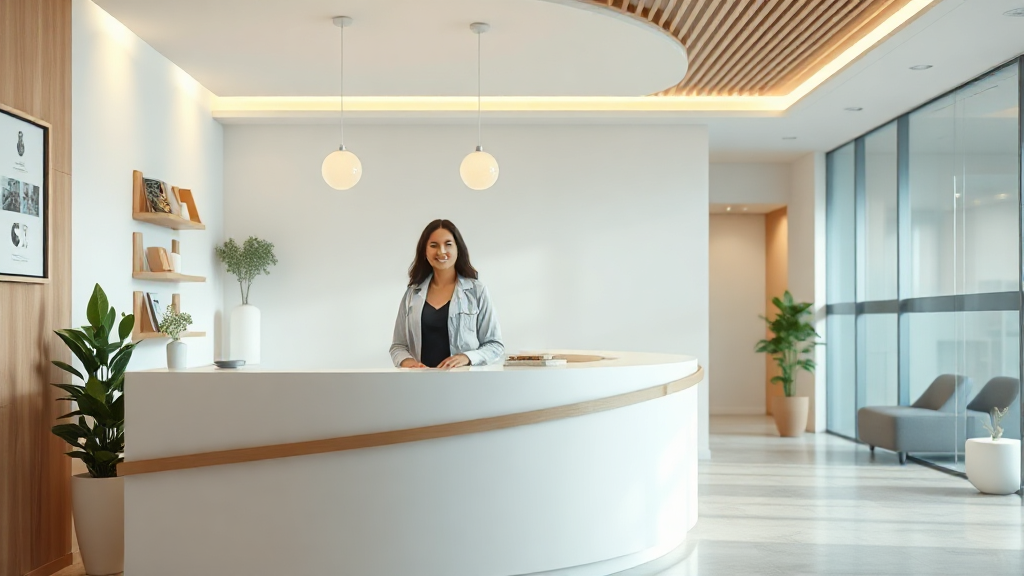
A calm front desk is felt throughout the practice. Hygienists are no longer pulled in to cover the phone. The coordinator can greet each patient without one ear on the line. And the patient in the chair no longer hears a noisy waiting room in the background. For a practice in Burnaby BC, Surrey BC, Halifax NS, or Winnipeg MB, that calm becomes a retention argument as strong as the quality of care itself.
The full list of tasks Sophie can absorb is set out here: https://dentists.agentiavocal.ca/en/features . To estimate the time and revenue recovered in your own practice, the calculator is available at https://dentists.agentiavocal.ca/en/roi-calculator .
Compliance, without a burden on the team
All data stays in Canada, hosted on AWS infrastructure in the ca-central-1 region in Montreal. Processing follows PIPEDA, and Quebec Law 25 where applicable. Call recordings are kept for 90 days by default — an adjustable setting — then deleted automatically. Sophie works within the requirements of the RCDSO in Ontario, and the same rigour applies to practices governed by the CDSBC in British Columbia, the ADA+C in Alberta, or the ODQ in Quebec.
None of this adds work to your front desk: all setup and integration is carried out by the TECHMA team. The practice configures nothing.
What it costs
Pricing is simple and predictable. The Essentiel plan is 299 $CAD/month for one practice with 200 minutes included. The Croissance plan, at 599 $CAD/month, raises the included time to 600 minutes. The Multi-cabinets plan, at 899 $CAD/month, covers up to three sites. Additional minutes are billed at 0.35 $CAD/min, and the initial deployment is a one-time 999 $CAD fee. The details are at https://dentists.agentiavocal.ca/en/pricing , with a comparison to other approaches on the market at https://dentists.agentiavocal.ca/en/vs-dentina .
A retention factor for staff
Turnover at the front desk is one of the most expensive problems a practice faces. Training a new coordinator takes weeks, and every departure strains the relationship with regular patients. Much of that burnout comes precisely from the constant pressure: answer, note, call back, all while keeping a smile at the counter. By removing the background noise of routine calls, Sophie gives the team a sustainable pace again. The coordinator stops being an overwhelmed switchboard operator and becomes what the role should be: the person who welcomes, directs, and reassures. For a practice in Halifax NS or Winnipeg MB that struggles to recruit, this quality of working life is no small thing — it is often what separates a job people keep from one they leave.
Taking back control of the line
Reducing interruptions is not a matter of individual discipline: it is a matter of architecture. As long as the same counter has to handle the phone, the patients present, and the administration, interruptions are inevitable. By handing the first telephone line to Sophie, you give your team back its scarcest resource — attention — and point it where it matters most: at the patient in front of them.
To hear how Sophie answers a real call, book a live demo at https://dentists.agentiavocal.ca/en/live-demo .