Warm Transfer to a Human: When and How the AI Receptionist Hands Off the Call
How the Agent IA Vocal virtual receptionist warm-transfers a dental practice call to your team: emergencies, clinical questions and explicit patient requests.
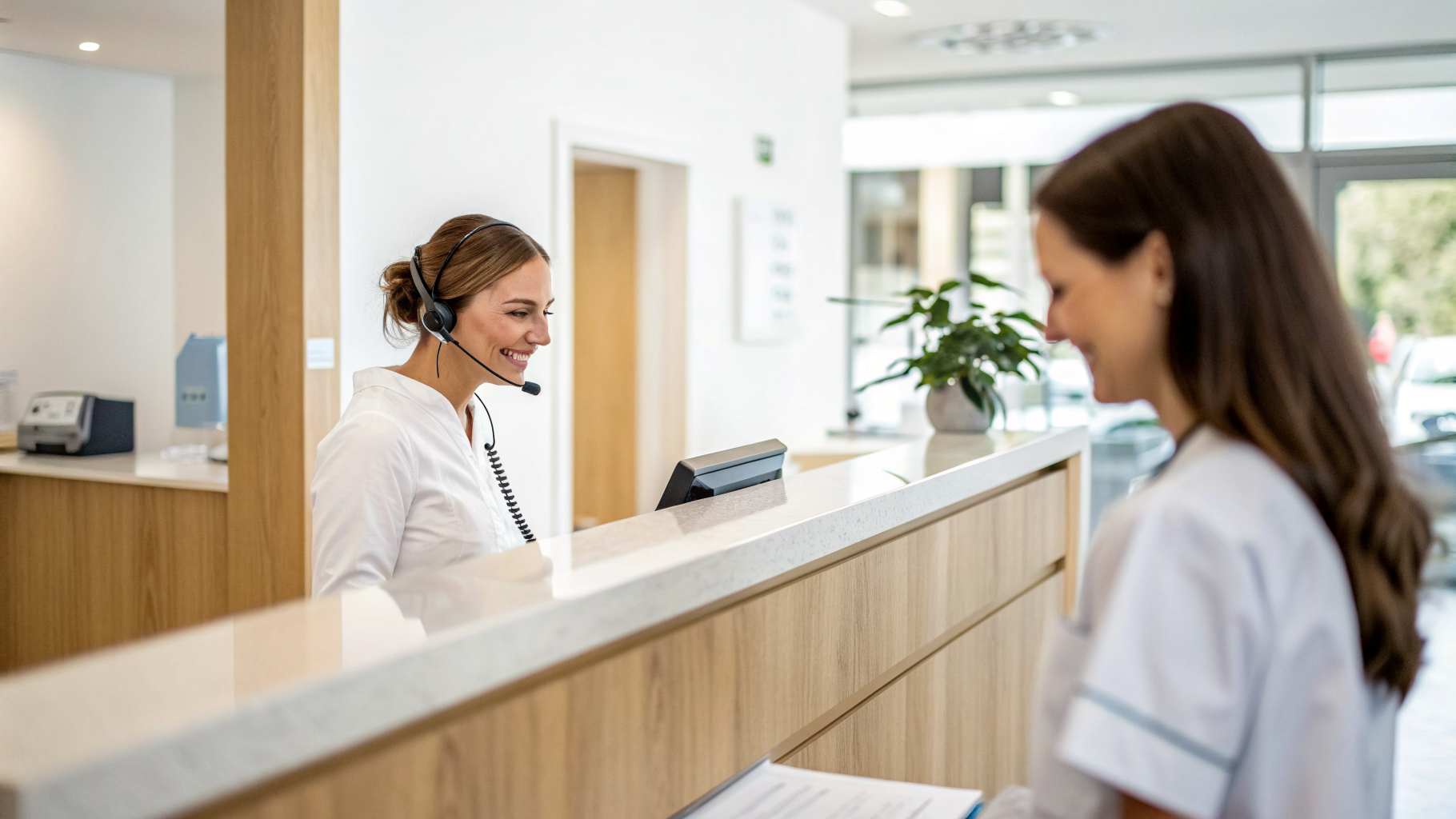
The "automated trap" fear: the real objection
When a dental practice considers handing its phone reception to a virtual receptionist, the first worry is rarely the price or the technology. It is more human: "What if a patient in pain reaches a system that loops forever and never transfers them to a real person?" The concern is fair. A patient in Hamilton, Ontario calling at 8 a.m. with a fractured tooth does not want to navigate a menu; they want to be heard, then taken care of. Agent IA Vocal was built around that reality. Sophie, your virtual front-desk receptionist, is not there to trap calls — she is there to qualify them and, at the right moment, hand them off to your team.
This article explains exactly how Sophie decides to transfer a call to a member of your staff, how a warm transfer works, and why this handoff mechanism separates a useful virtual receptionist from a dressed-up answering machine.
What Sophie handles alone, and what she transfers
Most calls to a dental practice are repetitive and perfectly manageable without a human: booking and confirming appointments, questions about hours, directions or parking, hygiene recalls, callback requests, and first-line insurance questions. Sophie handles these around the clock, in English and French (en-CA and fr-CA), and will switch language mid-call if the patient does.
But some situations need a person. Sophie recognizes them and triggers a transfer instead of improvising. Three categories always warrant the handoff.
The three transfer signals
Distress or emergency. A patient describing severe pain, trauma (a knocked-out tooth, bleeding, swelling) or emotional distress is routed immediately into triage and, when needed, to a team member. Sophie applies a three-level triage — same day, 48 hours, this week — without ever offering a diagnosis.
Clinical questions. The moment a question goes beyond the administrative ("Is this antibiotic compatible with…?", "Is this symptom normal after my surgery?"), Sophie does not guess. She transfers to the qualified person or takes a structured message for a prompt callback.
An explicit request. If a patient simply says "I would rather speak to someone," Sophie does not push back and does not try to keep them on the line. She transfers. The right to reach a human is never taken away from the caller.
How a warm transfer works
A warm transfer is more than making another extension ring. Before passing the call, Sophie summarizes the context: who is calling, why, and what has already been said. Your front-desk coordinator in Mississauga, Ontario or Calgary, Alberta does not restart the conversation from scratch; the call arrives with the patient's name, the reason and the urgency level already established. The patient does not repeat themselves, and your team saves precious seconds on every call.
When the team is available, the handoff happens live. When they are busy — chairside, at the counter with another patient, in Edmonton, Alberta as in Burnaby, British Columbia — Sophie offers clear options: leave a message logged in your software, schedule a callback at a set time, or, for an emergency, follow the triage protocol you defined.
Emergencies and distress: the priority transfer
For a practice, the emergency call is both the most stressful and the most valuable. Sophie treats it as a priority. She gathers the essentials — nature of the problem, how long, any recent treatment — classifies the call under your three-level triage, then triggers the transfer or the emergency procedure. After hours, in Halifax, Nova Scotia or Winnipeg, Manitoba, she follows exactly the protocol you set: the on-call dentist's emergency line, a priority message, or a first-thing callback instruction. Nothing is left to chance, and no urgent call is lost in a voicemail box.
The full triage logic and the supported scenarios are described at https://dentists.agentiavocal.ca/en/features
Clinical questions: never a diagnosis
This is an absolute rule: Sophie never offers a diagnosis and never gives clinical advice. This limit is not a weakness, it is a safeguard. It avoids wrong guidance, respects the scope of practice reserved for licensed professionals, and protects you with your regulatory college — the Royal College of Dental Surgeons of Ontario (RCDSO), the College of Dental Surgeons of British Columbia (CDSBC), the Alberta Dental Association and College (ADA+C), or, where applicable, the Ordre des dentistes du Québec. When a patient asks a clinical question, Sophie rephrases it, sets a clear expectation for the reply, and transfers to the right person or logs a precise message for a callback.
What happens when no one is available
No team is reachable every minute. The point of a virtual receptionist is precisely to never leave a call unanswered, even when a live human transfer is not possible right then. In that case Sophie does not hang up and does not dump the caller into an anonymous machine. She collects the information, sets a clear expectation ("a team member will call you back before noon"), and triggers the automated reminders at D-7, D-2, D-1 and H+15 so the loop closes. The patient feels taken care of; your team gets an organized queue instead of a pile of voicemails to decode.
Why a well-designed handoff protects your revenue
Every mishandled call has a cost. A new patient who reaches a voicemail rarely calls back: they dial the next practice on the list. An untriaged emergency becomes a visit somewhere else, sometimes for good. By qualifying every call and transferring at the right moment, Sophie protects exactly the calls that earn: the new-patient inquiry, the emergency that fills a same-day opening, the high-value treatment question that was waiting for an answer. The handoff is not only a matter of service; it is a net that keeps your revenue from leaking to competitors while your team is busy chairside.
Integration with your practice software
A transfer is only useful if it leaves a usable trace. Sophie writes the call reason, the urgency level and the summary straight into your practice management software — Open Dental, Dentitek, ClearDent, Dentrix Canada, Maxident, ABELDent, Curve or tracker.tab32. The appointment booked during the call lands in the right slot; the message left after an impossible transfer lands in the right patient chart. Your coordinator re-enters nothing.
Compliance and privacy
Every transferred or logged call contains personal health information. Agent IA Vocal stores data in Canada (AWS, ca-central-1 region, in Montreal), in line with PIPEDA and, where applicable, Quebec Law 25. Recordings are kept for 90 days by default — the period is configurable — then deleted automatically. The context passed during a transfer stays inside your practice and your software; it is not exposed to third parties.
Measuring the impact
The transfer mechanism has a direct, measurable effect. Urgent calls stop getting lost; routine requests are settled without tying up your staff; and patients who ask for a human get one, which preserves trust. On missed appointments, practices see no-show rates move from about 14.2% to 8.8% — a 38% drop — thanks to the automated reminders attached to every booking. You can estimate the effect on your own practice with the calculator at https://dentists.agentiavocal.ca/en/roi-calculator
What it costs
Pricing is simple and predictable. The Essentiel plan is 299 $CAD/month for one practice with 200 minutes included. The Croissance plan is 599 $CAD/month with 600 minutes. The Multi-cabinets plan is 899 $CAD/month for up to three locations. Extra minutes are billed at 0.35 $CAD/min, and the initial deployment is a one-time 999 $CAD fee. The details are at https://dentists.agentiavocal.ca/en/pricing
Deployment is done for you
You configure nothing. The TECHMA team sets up the transfer rules, the emergency triage, the after-hours protocols and the software integration end to end. You describe how your front desk works today; we reproduce your instructions, station by station. There is no software for your office to install and no settings for your coordinator to maintain.
Next step
The best way to judge the quality of a warm transfer is to hear it. Book a live demo: you will call Sophie, test an emergency scenario and a transfer request, and judge for yourself. It is at https://dentists.agentiavocal.ca/en/live-demo